Fluent in Two Weeks: The Stack Is No Longer the Moat
The production incident last week made a point I want to sit with a bit longer. AI accelerated the diagnosis and fix. It also helped draft the runbook that left the security gap in the first place. Same tool, wildly different outcomes—because the difference wasn’t the tool, it was the judgment behind it.
There’s another story running parallel to that one. When I pivoted to ClickNBack, I chose Python and FastAPI—not Java, the language I’d spent months arguing was the right foundation for serious backend work. Not Swift, the language I’d spent six years in. Python: a stack I’d kept at a deliberate arm’s length. I was shipping production-quality backend code two weeks later. That deserves an explanation.
Why I Resisted Python in the First Place
When evaluating languages for PermaTechHub, I looked at Python and set it aside. Dynamic typing at scale has real costs, and Python’s flexibility makes it easy to write code that works today and surprises you in production six months from now. I also spent time with Elixir—and after more than a year in a scale-up startup, the functional paradigm was no mystery. Pattern matching, immutable data by default, a runtime built around fault tolerance: all familiar territory. The real reason I didn’t choose Elixir, though, is that it’s not a good lingua franca to showcase your skills. The ecosystem is too niche for most audiences, and while I love the paradigm, I needed a platform that would make my work legible and relevant to a broader set of teams and recruiters.
So I chose Java: deliberate, justified, and sound reasoning at the time. Then the pivot came, and with it, an opportunity to test an idea I’d been quietly forming.
Two Weeks Is Not a Long Time—But It Was Enough
Here’s what being productive in Python in two weeks actually looked like: async route handlers in FastAPI, SQLAlchemy with transaction-level control, Pydantic schemas, Alembic migrations, background jobs with configurable retry logic, a three-state wallet model with Decimal arithmetic precise enough for financial transactions. Not tutorial code. The same system you’ve been reading about.
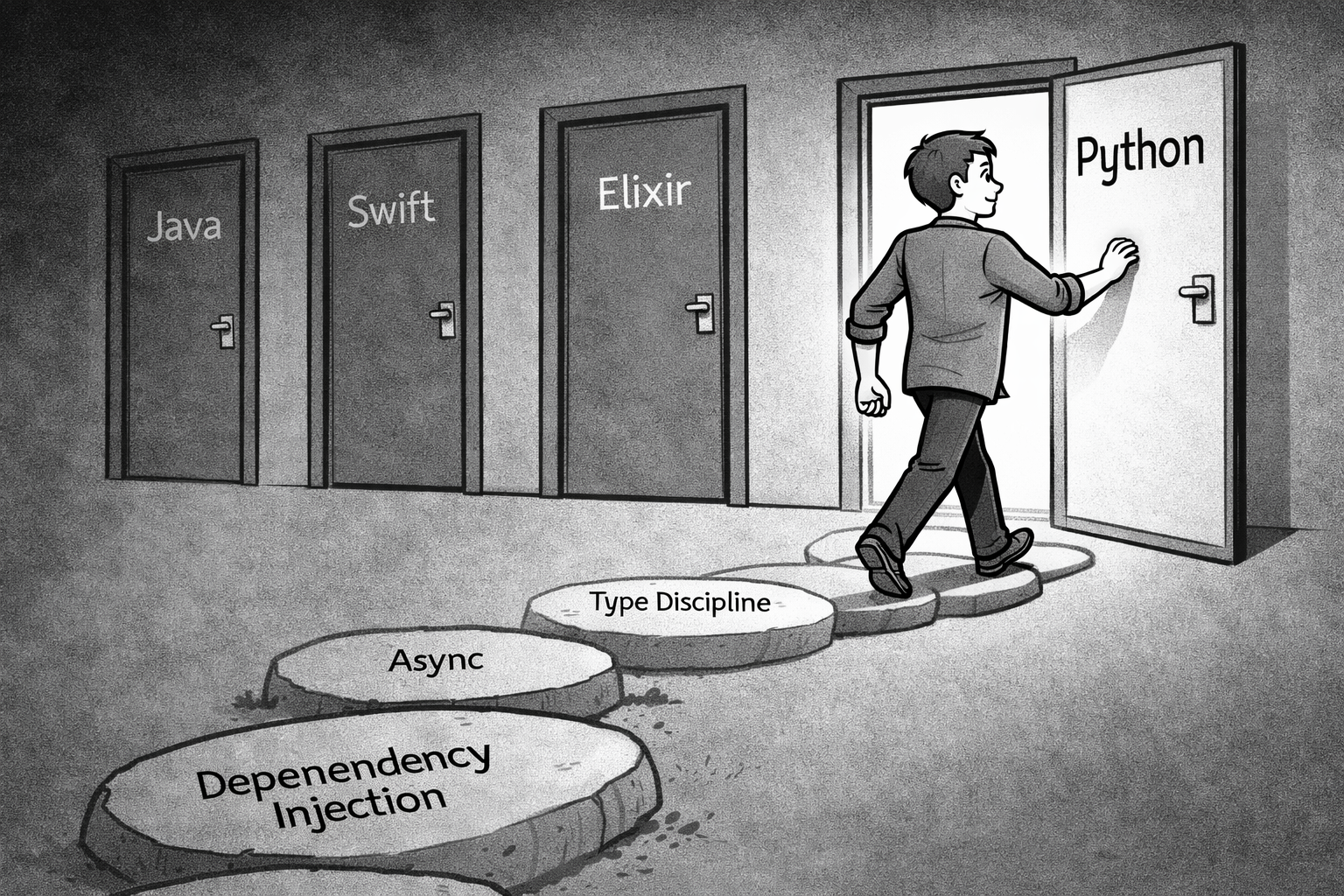
The reason it worked is that I wasn’t learning from scratch—I was translating across paradigms. Async programming? Six years of Swift taught me the mental model long before Python’s syntax did. Dependency injection? Java made it second nature. Strong type discipline? Working with Pydantic and type hints feels familiar when a compiler has argued with you for years. The concepts transferred; only the idioms needed learning.
What AI did was collapse that idiom phase. Not by writing the system for me—if it had, the runbook incident would have repeated itself at the architectural level—but by answering “how does Python express this pattern I already know?” at the speed of thought. That’s a very different thing from asking AI to design the system.
The Concept Is the Durable Thing
Here’s what this experience made impossible to ignore: technical knowledge lives in concepts, not syntax. A language is a vehicle. The routes—domain modeling, failure mode thinking, system design, test discipline, operational judgment—are the same regardless of what vehicle you’re driving.
This is why the engineers who are hardest to replace aren’t defined by a single stack. They’re defined by the clarity of their conceptual thinking and the consistency of their judgment. Stack fluency is useful. Stack flexibility is rare. The ability to walk into an unfamiliar codebase, understand what it’s trying to do, and contribute meaningfully within days—that’s the skill that scales.
What This Means If You’re Still Betting on One Language
AI has permanently compressed language acquisition. What used to require years of professional exposure now takes weeks—provided you bring the right foundation with you. That’s not a threat to engineers who think in concepts; it’s a force multiplier. It is a threat to engineers whose expertise is primarily syntactic.
The lesson I keep returning to: be willing to learn, stay flexible, and apply judgment in everything you do. The stack will change. Business requirements will shift. The problem domain will surprise you. The engineers who thrive aren’t those who know Java or Python or Elixir most deeply—they’re the ones who know what they’re trying to build well enough to learn whatever tool gets them there.
Six years in Swift. A detour through Elixir. A deliberate Java choice. Two weeks in Python. The stack changed every time. The craft didn’t.