From User Stories to Functional Requirements: A Disciplined Process
In a previous post, I shared how I turned a sprawling product vision for PermaTechHub into a focused, achievable MVP. Today, I’m diving into what came next: translating those high-level user stories into detailed, testable functional requirements. This is where engineering discipline separates serious projects from vibe-coding experiments. AI agents can help, but only if you bring critical thinking and relentless attention to detail. Let me show you how it went.
Starting with the Right Foundation
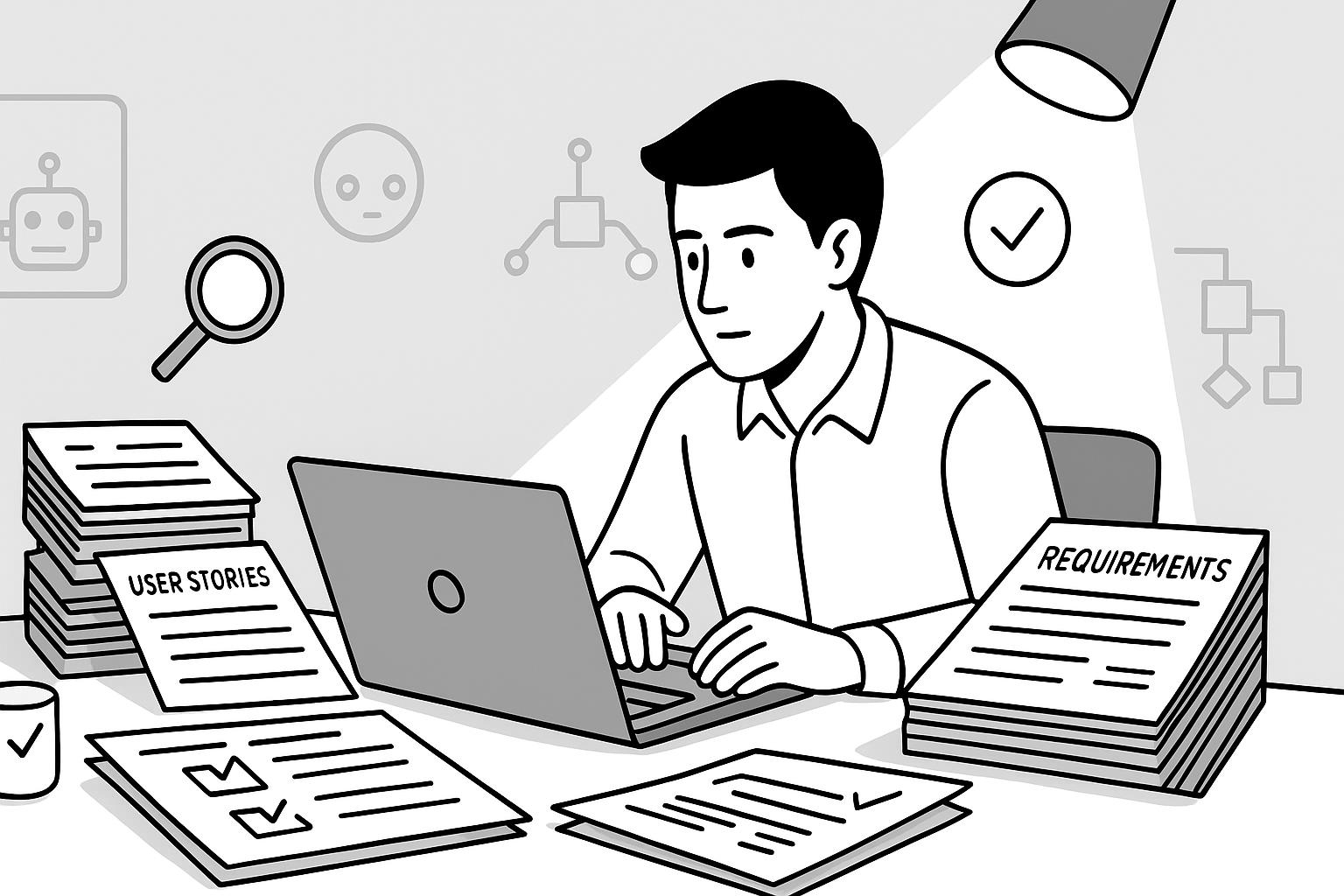
My MVP features document started with broad user stories organized into sections (i.e. features): User Accounts & Authentication, Marketplace Listings, Transaction Flow, Moderation, and Observability. Each story followed the classic format: “As a [role], I want [feature] so that [benefit].”
But not all user stories are created equal. Some were too broad, others mixed concerns, and a few used vague language that would have caused chaos during implementation. Before I could write functional requirements, I needed to refine and clarify every single user story.
Even the way I grouped features needed a rethink. My original “User Accounts & Authentication” feature mixed account management, authentication, and dashboard functionality. Lumping these together would have made requirements messy and APIs harder to reason about. So I split them into three: User Accounts, User Dashboard, and Authentication. Each can now evolve independently. This is about separation of concerns at the requirements level—get it wrong early, and you’ll pay for it later.
Confronting Ambiguity Head-On
The next challenge was fixing ambiguous user stories. For example, “As a user, I want to manage my profile information…” What does “manage” mean? Update name? Change email? Delete account? Ambiguity is the enemy of good requirements. I broke this down into atomic, specific stories: update profile, delete account (with soft deletion). Each maps to a single, testable operation. No guesswork, no hidden complexity.
Similarly, stories about “viewing and managing” listings in a dashboard were clarified—since CRUD was already covered elsewhere, dashboard stories focus only on viewing. This process of ruthlessly interrogating every user story for precision took time, but it was essential. AI can help, but only if you ask the right questions and push for precision.
Designing the Functional Requirement Template
With clean user stories, I needed a consistent structure for documenting functional requirements. I built a template covering essentials: user story for context, constraints for validation, acceptance criteria for testability, and use cases for both happy and sad paths. One crucial detail: always specify HTTP status codes in acceptance criteria and use cases. “HTTP 200 OK” is clear; “the system responds successfully” is not.
To make the process even smoother, I created a meta-template—a markdown file with instructions for generating new FRs, whether manually or with AI. These rules ensure consistency across all FR documents, so documentation feels cohesive rather than like a patchwork of styles. This structure and meta-template together keep everyone on the same page and make sure nothing important slips through the cracks.
While refining requirements, I also spotted patterns that help avoid redundancy. For example, almost every authenticated user operation has the same sad path—return 401 Unauthorized if the user isn’t authenticated. Instead of repeating this in every FR, I document it once in a global policy. The same goes for idempotent operations like logout: always return HTTP 200 OK, regardless of token state. This isn’t just about simplicity—it’s about security. Document these constraints explicitly, but don’t repeat yourself. These shared rules make requirements easier to maintain and clearer for everyone involved.
The Role of AI: Speed, Not Thought
AI agents can accelerate this work, but they cannot replace critical thinking. I use AI to generate initial drafts of FRs, but every document requires careful review and revision. AI misses nuances, introduces inconsistencies, and sometimes misinterprets context. It’s a tool, not a thinker. The workflow: refine user stories, use AI for a draft, then review and iterate until the document is clear and testable. The AI follows your lead, not the other way around.
This is the opposite of vibe-coding. You’re not blindly accepting AI output. You’re using AI for repetitive work—freeing your brain for precision, consistency, and strategic thinking.
Sometimes the AI misses things obvious to someone with experience. For example, when documenting the login flow, the AI suggested “authentication tokens must be securely generated and stored.” But with JWTs for stateless authentication, you don’t store tokens server-side. Only if you need revocation do you store refresh tokens. For a simple MVP, no server-side token storage is needed. I reoriented the constraint to clarify: “Authentication tokens (JWTs) must be securely generated and signed; tokens are not stored server-side.” Small detail, huge architectural implication.
When AI Gets It Wrong: The Soft Deletion Story
Here’s a perfect example of why critical thinking matters more than speed. When I asked the AI to generate the functional requirement for “delete account,” it defined a delete operation—no nuance, just “user deletes account, account is gone.”
But deletions are tricky. Hard deletion is rarely the right answer. What about compliance, accidental deletions, or data integrity? The AI didn’t consider any of this. The problem was that I hadn’t given it enough context or constraints.
So I made a call: soft deletion. Mark the account as deleted, exclude it from user-facing views, but don’t physically remove it. This protects user data for compliance, prevents accidental loss, and leaves an audit trail. The functional requirement now documents this clearly.
This is the real value of having a human in the loop. AI can generate requirements fast, but it can’t bring experience, judgment, or awareness of best practices. It doesn’t know that certain operations—like deletions or authentication—come with hidden complexity. You have to catch those moments and course-correct.
It’s not about the AI being “bad”—it’s about recognizing that software engineering is a decision-making discipline. AI is a tool to accelerate the work, but the engineering judgment? That’s all you.
Another example: when I reviewed the login FR, I noticed the constraint about account lockout was vague. It said “the system locks the account after too many failed attempts,” but it didn’t specify how many attempts, how long the lockout lasts, or how the account gets unlocked. These aren’t just implementation details—they’re critical policy decisions that affect both security and user experience. I pushed the AI to be explicit: “The system must lock a user account after a configurable number of consecutive failed login attempts (e.g., 5 attempts). When locked, the account cannot be used to log in until the lockout period expires (e.g., 15 minutes) or the user completes a defined unlock process (such as a password reset or admin intervention).” Now there’s no ambiguity, and anyone implementing this knows exactly what to build.
Similarly, the logout FR originally said “the system must handle logout requests gracefully even if the session is already expired or invalid.” What does “gracefully” mean? Does it return an error? Does it silently succeed? The AI didn’t catch this ambiguity. I asked: what does “handle gracefully” actually mean? The answer became explicit: “The system must always respond to logout requests with a generic success message and HTTP 200 OK, even if the authentication token is expired or invalid. No information about token validity should be revealed.” Now it’s clear, testable, and secure. Vague adverbs like “gracefully” or “properly” are red flags—they need to be replaced with concrete behavior.
What This Process Teaches You
What did I learn from all this? First, ambiguity is expensive—every vague word or mixed concern in a user story will come back to haunt you, usually in the form of bugs, confusion, or endless back-and-forth during implementation. Templates are a lifesaver; they take the guesswork out of documentation and keep everyone on the same page, literally. AI agents? They’re fantastic for speeding things up, but only if you’re willing to bring discipline and a healthy dose of skepticism to the table. You can’t just let them run wild and hope for the best.
And maybe the biggest lesson: requirements are living documents. You don’t have to get every detail perfect on day one. You can—and should—refine as you go, especially when you hit real-world edge cases. But you do need a solid foundation, something that lets you build with confidence and adapt without chaos.
This isn’t glamorous work. It’s not the kind of thing that makes for flashy demos or viral tweets. But it’s the foundation of good engineering. It’s what separates projects that scale from projects that collapse under their own complexity.
What’s Next
With functional requirements in place for User Accounts and Authentication, I’m ready to move on to the next sections: Marketplace Listings, Transaction Flow, and Moderation. Each will follow the same disciplined process: refine features and user stories, document constraints, write acceptance criteria, define use cases, and review relentlessly.
The goal isn’t to document everything to the last detail—it’s to document enough to build confidently. Requirements are tools, not bureaucracy. They exist to help you think clearly, communicate effectively, and build systems that work.
And that’s the whole point, isn’t it? To build something that lasts, scales, and reflects the values you care about. Not just for the MVP, but for the long haul.
If you’re working on your own project—whether it’s a demo, a side project, or a production system—take the time to get your requirements right. It’s not sexy, but it’s the difference between software that works and software that doesn’t.
Next time, I’ll walk through designing the API and defining the technical architecture. But for now, the foundation is solid. And that’s what matters.